
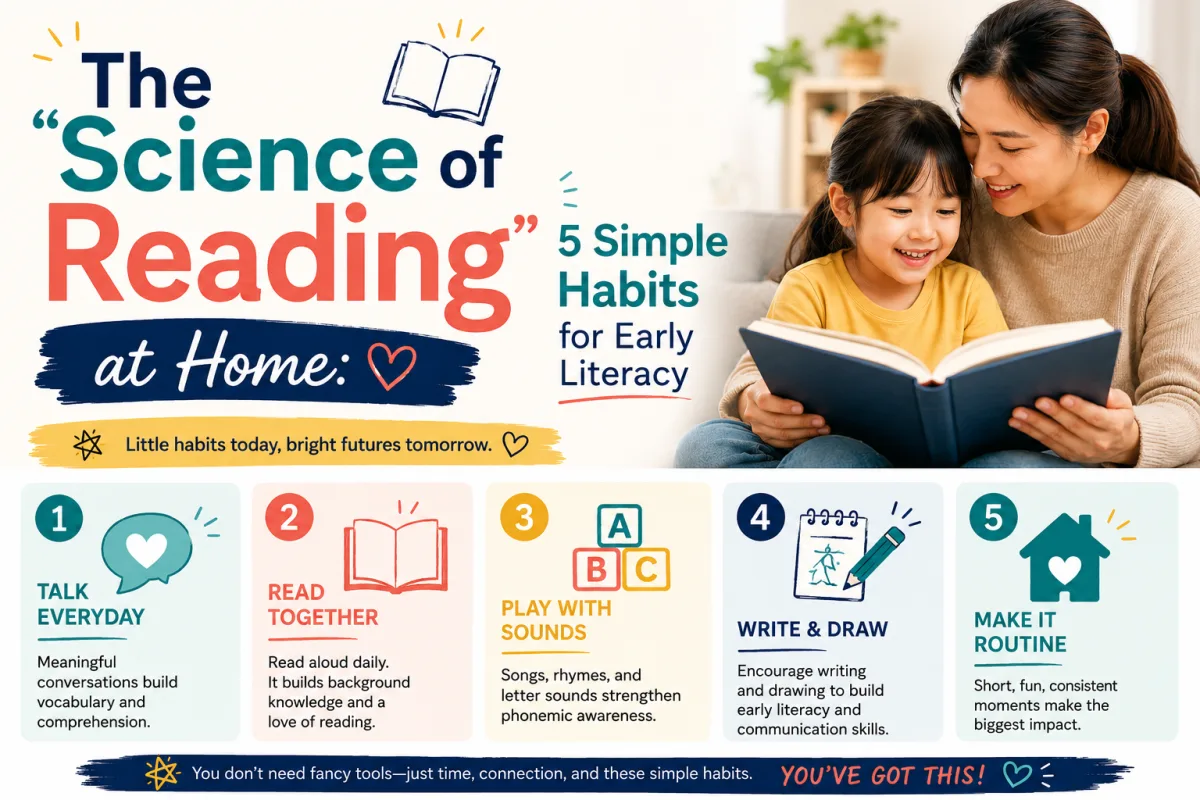
If you have browsed an education blog or sat through a school board meeting recently you have likely heard the phrase "The Science of Reading." It sounds highly academic. It is not a trendy curriculum or a passing fad. The Science of Reading is a body of research that proves exactly how the human brain learns to read.
The biggest takeaway from The Science of Reading is that reading is not natural. Unlike speaking which our brains pick up reading requires rewiring the brain to link letters to spoken sounds.
While schools handle instruction a recent report highlighted a worrying trend: daily parent-child reading and language engagement has dropped significantly due to busy work schedules.
Fortunately you can support literacy with a few small changes in your daily routine. Here are 5 habits parents can build:
1. Don’t Let Them Guess (Sound It Out Instead)
When an early reader hits an unfamiliar word, a common instinct is to say, "Look at the picture what do you think it is?" or "Guess based on the first letter!". The Science of Reading tells us that guessing is a bad habit. It trains the brain to look away from the text. Instead teach them to decode.
The Shift: When your child gets stuck point directly to the letters. Guide them to say each sound from left to right and then smoothly blend them together.
2. Play Sound Games on the Go (Phonemic Awareness)
Before children can read words they need to hear the individual sounds inside words. This is called awareness. You can build this skill while driving or making dinner.
The "First Sound" Game: "I spy something that starts with the sound /bbb/. What is it?"
3. Map Words with "Sound Buttons"
of forcing your child to memorize words by sight help them connect the sounds they hear to the letters they see. This process is called mapping.
The "Sound Button" Routine: Say a word. Have your child tap a "button" for every sound they hear. Write the letters that make those sounds above the buttons.
4. Read Aloud Books They Can’t Read Yet
There is a difference between a childs decoding level and their comprehension level. Don't just read beginner books to your child. Read stories and kid-friendly informational books aloud.
5. Have "Before, During and After" Conversations
Reading isn't about pronouncing words correctly; it's, about making meaning. You can boost your child’s comprehension skills by turning storytime into a conversation using open-ended questions.